|
Three students from the University of Maryland’s Department of Aerospace Engineering have received National Science Foundation (NSF) Graduate Research Fellowships, one of the nation’s most prestigious honors for graduate students pursuing research in science, technology, engineering, and mathematics (STEM).
This year’s aerospace engineering recipients are conducting research spanning aerial robotics, planetary science, and space-based sensing systems.
Advancing autonomous systems and orbital debris detection

Adam Ben Youssef received his fellowship for research in the areas of control theory and machine learning for aerial robotics.
Advised by Professor Christine Hartzell, Ben Youssef's current work in the Planetary Surfaces and Spacecraft Lab supports a mission concept focused on detecting small orbital debris in low Earth orbit through the plasma waves generated by impacts. As part of that work, he is developing high-fidelity simulations to evaluate the concept’s feasibility.
Additional research at UMD has included projects related to astronaut support systems and magnetic granular material behavior.
Outside the university, Ben Youssef has completed internships at Blue Origin, NASA Johnson Space Center, and SpaceX, gaining experience in propulsion systems, EVA flight operations, and launch hardware engineering.
“I am incredibly grateful to have received this opportunity to pursue my interests and be supported financially through the NSF,” said Ben Youssef. “I hope to take advantage of this opportunity to learn as much as I can and contribute to the field of research in a meaningful way!”
Supporting the future of planetary defense
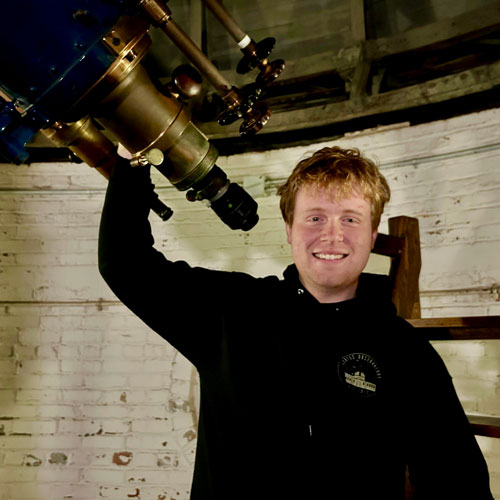
Erik Payton received his NSF Fellowship for research related to planetary defense and space-based observatories.
A first-year Ph.D. student in the Strategic Space Sensing Laboratory under Assistant Professor Tam Nguyen, Payton studies the feasibility of space-based observatory architectures for asteroid detection and space situational awareness.
Originally from West Charlton, New York, Payton earned his bachelor’s degree in mechanical engineering from Cornell University before joining UMD’s aerospace engineering graduate program.
This summer, he will intern at NASA Goddard Space Flight Center as he continues research focused on planetary defense technologies.
“I am so grateful to have the opportunity to pursue research that interests me,” said Payton. “And I am excited to see what contributions I will make to the field of Planetary Defense with the support of the fellowship.”
He hopes to build a career in planetary defense through work in government, academia, or industry.
Exploring the habitability of Europa
 Akemi Takeuchi received her NSF Fellowship in geoscience for proposed research focused on Europa, Jupiter’s icy moon. Akemi Takeuchi received her NSF Fellowship in geoscience for proposed research focused on Europa, Jupiter’s icy moon.
Her research aims to better understand the composition of Europa’s surface and what it may reveal about the moon’s subsurface ocean and potential habitability. Through laboratory experiments, she plans to study how irradiated salt mixtures behave across visible to near-infrared wavelengths, helping scientists better interpret spectroscopic data from missions such as NASA’s Europa Clipper.
Takeuchi’s proposed research was advised by Dr. Karl Hibbitts and Dr. Jodi Berdis at the Johns Hopkins University Applied Physics Laboratory.
At UMD, she is active in the Nearspace Balloon Payload Program under Dr. Mary Bowden, where she helped develop payloads for micrometeorite collection, neutral buoyancy experiments in the stratosphere, and other engineering applications. She has also conducted research related to the moon and Comet 67P.
After graduation, she plans to pursue a Ph.D. in planetary science.
About the NSF Graduate Research Fellowship Program
The NSF Graduate Research Fellowship Program supports outstanding students pursuing research-based master’s and doctoral degrees and provides three years of financial support for graduate study and research, helping students pursue ambitious projects that address scientific and technological challenges.
Related Articles:
Congratulations to Aerospace Engineering’s Class of ’26 Early Career Distinguished Alumni
Wielgosz Receives ARCS MWC Foundation Scholarship
Student Success at SAMPE 2026
Melissa Buys Earns Presentation Award at SSPI–Mid Atlantic Student Competition
Congratulations to our 2026 Department and College Honors and Award Recipients
UMD Students Earn Top Honors at AIAA Regional Conference
Pines elected to American Academy of Arts and Sciences
Nine UMD Students Receive Vertical Flight Foundation Scholarships
Calling Creative Thinkers: We’ve Got a New Opportunity for You
Morcos Awarded UMD Ann G. Wylie Dissertation Fellowship
May 6, 2026
|





